Skip to Content

The new newsroom

TikTok and news consumption
TikTok has transformed the lives of millions — shaping culture and influencing fashion — and also instrumental in spreading information worldwide.
Avery Boyle
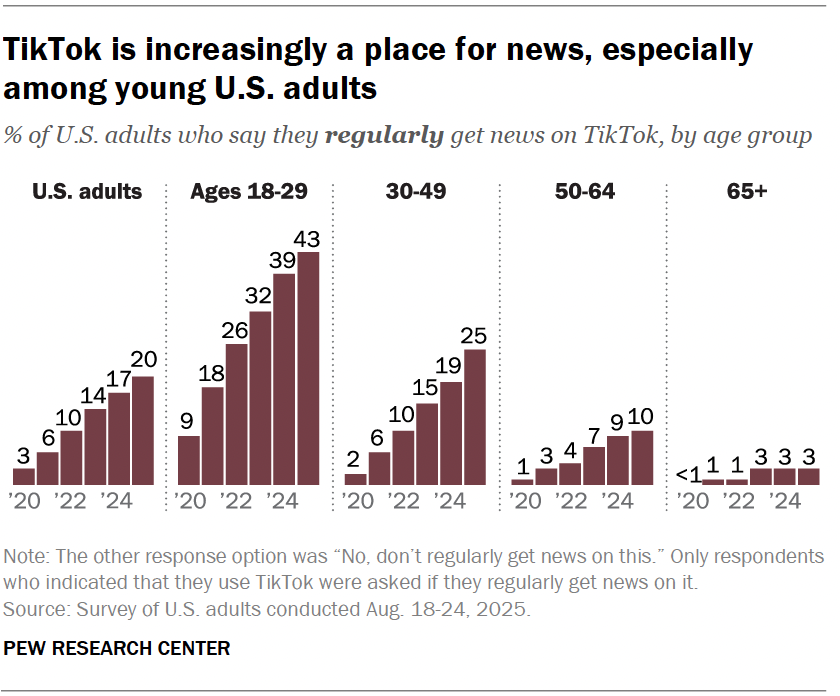
As time progresses, young adults are increasingly receiving their news from TikTok. (Pew Research Center)

News in sixty seconds.

A student hearts a video, checks the comments and then scrolls. 

This is the cadence of 56% of young Americans every day. TikTok has transformed the lives of millions — shaping culture and influencing fashion — and has also been instrumental in spreading information worldwide. A survey conducted among juniors at Hebron concluded that 65% of the 20 students participating use TikTok as their main source of news. 

In eight years since its merging with short-form video app Musical.ly, TikTok has become the top social media platform in the world, with almost 2 billion users monthly. 

“I have a short attention span,” junior Diya Joseph said. “On TikTok, I can just swipe and swipe and see a bunch of cool things. Shorter videos are just more entertaining [for me].”

News at the fingertips

The digitalization of news has made global scale information available to more people.

“Now, [news] is way easier, shorter and more compact,” junior Adrian Nyamongo said. “I can get the main ideas without having to watch a full news program.”

TikTok has become a consistent source of news stories for young people. In January of 2026, TikTok became the top news source for Americans ages 18-29. Associated Press reported that short, concise videos help news become more available to people. 

“TikTok has made news more fun for me,” Nyamongo said. “I can absorb information while [enjoying myself] scrolling, instead of the traditional way like on a TV.

The growth of TikTok as a news source coincides with the all-time high reports of misinformation. Pew Research shows less than 1% of the accounts people follow on TikTok are actually from institutional news sources. With its short-form video content, reported by Capitol Technology University, TikTok provides a platform for false information to be presented as credible. Inaccurate facts are deliberately spread on the app to harm others – a process called disinformation.

“I know what I see on TikTok is not always accurate,” Joseph said. “It’s [full of] people’s opinions [and agendas], and a lot of the time, people are wrong.”

Facts, filtered

Newsguard states that TikTok has long been considered the “new Google.” What separates the app from the search engine, however, is the lack of reliable sources and security of knowing accurate information is being presented. Newsguard reports that 1 in 5 TikToks are fueled by misinformation. 

“It’s pretty weird because TikTok is replacing real new sources like CNN and CBS,” junior Jacob Tran said. “Things like that are definitely more credible because it’s more controlled. On TikTok, anyone can make content or news just for likes and views.”

According to the Guardian, over half of the top 100 videos discussing mental health aid contain amounts of misinformation. 

Additionally, other medical advice presented on the app has caused harm to those participating, such as on “#sinustok” where unlicensed creators recommended shoving garlic up one’s nose to unclog sinuses. This caused irritation and nasal tissue damage to viewers who attempted this remedy.

“It’s scary,” said Tran. “You don’t really know for sure if what you’re watching is the truth.”

News literacy — the ability to analyze and verify the credibility of news critically — is rapidly declining within young people in America

News literacy in the TikTok era

Before TikTok, news primarily was spread through radios, television and physical papers. Information moved slower and followed editorial guidelines and fact-checking. 

“Back then, you had to go to a very specific news outlet or resource,” AP English Language and Composition teacher Nicole Perkins said. “But I feel like now you have regular people delivering that news information.” 

With the growth and integration of technology into our daily lives, the declining news literacy rates are brought into the classroom as well. In a survey conducted by Media Literacy Now, 38% of US adults have practiced news and media analysis in high school. 

“There’s more mediums we have to be aware of now to be able to spot something and tell if it’s credible,” Perkins said. “That’s not always in the scope of what we can do.”

A study by The Guardian in late 2025 finds there were over 1.3 billion artificially generated videos on the app – a number that has been increasing. The Guardian reports AI content videos are often used to spread misinformation. 

Celebrity interviews, political addresses and news reports have been faked using AI videos on the app to spread fear and harm others, and in a study conducted by Runway, 90% of people cannot tell if the videos they watch are AI.  

“I feel like with AI, it’s not easy to teach [news literacy],” Perkins said. “It’s just so new, you have to be aware of so many different things.”

According to the Australian Institute of Internet Affairs, it’s difficult to actively spot credibility on TikTok due to its algorithm. On TikTok, anyone can post, so authority and credibility are hard to establish. Creators are paid by engagement.

“In my opinion, the goals of [creators] on TikTok is to get views, likes and money,” Tran said. “They just want to catch the eye of people.”

Passive consumption also affects news literacy and makes way for an increase of inaccurate news. “Doom-scrolling” — excessive scrolling online regardless of how it makes you feel — allows for a lot of passive consumption of content. CNET reports that due to the sheer volume of videos posted on the app, it’s impossible for every TikTok to be fact-checked, because TikTok, although the primary source of news for most young Americans, isn’t built to be a news app. 

“When you’re in that doom-scrolling mindless spiral, you’re probably not going to [dig deeper] with what you’re watching,” Perkins said. “If you’re going to bring up something you saw later, you should probably preface it with ‘I saw this thing on TikTok’ [instead of presenting it as fact].”

Media Literacy Now reports that because TikTok is so heavily integrated in modern society, it’s not leaving, meaning improving the young generation’s news literacy is critical in defending against misinformation and fake news. 

Reasonable consumption

Viewers believe that TikTok regulations and national legislation needs to be passed in order to have TikTok become more credible and reliable. This sentiment is shared across the country, as 55% of Americans support legislation restricting false information and content..

“It seems difficult just because of the volume of videos that are being produced and posted,” junior Gavin McCain said. “But I think there should be more restrictions and TikTok should be working towards that.”

TikTok has publicly admitted to their role in platforming misinformation. By partnering with fact-checking organizations like PolitiFact and Snopes, there are now tools on the app’s interface to help viewers identify and report misinformation. 

“I know there’s a report feature now on TikTok for fake news,” McCain said. “I hope they’ll work toward adding more restrictions because [TikTok]’s the only way a lot of people get informed.”

According to Media Literacy Now, in addition to policies, young people are sharpening their discernment abilities to aid in responsibly consuming news and content. Using videos to inform yourself about current events is convenient and easy, but sourcing those videos from reputable news sources who have established accounts on TikTok – like The New York Times, ABC and The Washington Post – ensures information received is more credible and accurate. 

“TikTok isn’t going to just go away,” Tran said. “But if news stations are on TikTok, more controlled information is put out and they can help spread factual news to viewers like me.”

Teachers at Hebron have begun implementing news literacy in their instruction. In English and History classes, teachers ensure that students are acquiring the skills needed to understand media and news in a way that actively ensures accuracy by practicing analysis and credibility checks. By having those skills to recognize when something is false, they can stay informed without the fear of believing fake news. 

“[On TikTok], people are [always] going to make choices on how to inform others in order to cater to their audience and benefit them, so [if I teach my kids how to recognize that], we can keep that in the back of [our] mind when reading news,” Perkins said. “That way, we can get ahead of [misinformation] and be a little bit more critical up front instead of being reactive later.”