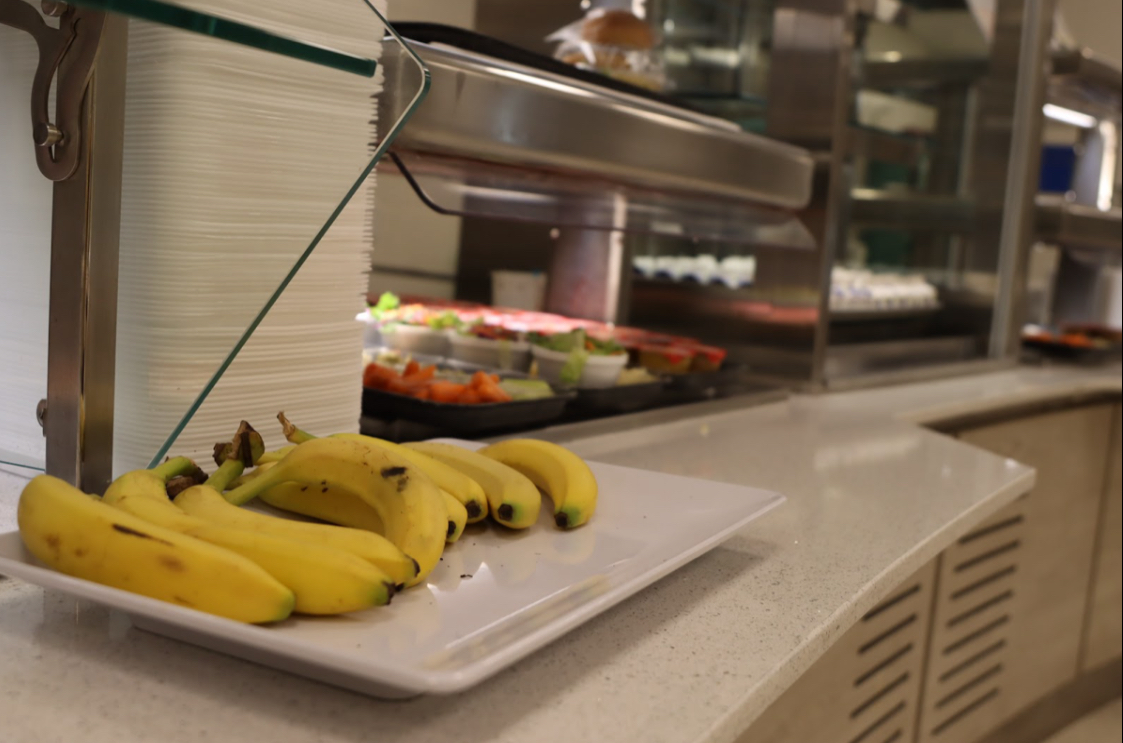
The federal government released new dietary guidelines on Jan. 7, 2026, marking the first time in U.S. history it issued a direct warning against ultra-processed foods.
Instead of the grain-heavy “MyPlate” model of the last decade, the new 2025-2030 Dietary Guidelines for Americans (DGA) prioritize whole, nutrient-dense foods: high-quality proteins, full-fat dairy and fresh vegetables led by Health and Human Services (HHS) Secretary Robert F. Kennedy Jr.
“The new pyramid better reflects what we now know about balanced nutrition and lifelong health,” fitness and wellness teacher Eby Muriel said. “We do not currently deep dive into nutrition as much as I would like to, which is one reason these updated guidelines are so helpful.”
The Food and Drug Administration (FDA) and the U.S. Department of Agriculture (USDA) is moving to align school meal programs with a “scratch-cooking” philosophy, shifting away from “heat-and-serve” food items to meals prepared with raw ingredients, free from the artificial dyes and excessive seed oils that the new administration has flagged as health risks.
“The school does not provide enough protein, fruits or vegetables, and I think they need to start incorporating fun meal ideas with high protein [instead of] the carb-heavy options,” junior Miriam Satyanathan said.
While the full transition of the National School Lunch Program can take years, students will see immediate shifts, such as stricter sugar limits, an increase in meat, eggs, and dairy-based entrees at breakfast and lunch and a gradual phase-out of packaged items.
“[Students cutting out sugar] will definitely feel better, have more energy and teachers will get more out of their classroom,” head track coach and health teacher Chance Edwards said.
On Jan. 14, the Whole Milk for Healthy Kids Act was officially implemented, allowing Texas schools to bring back whole and 2% milk — options that were restricted for over a decade in favor of skim and fat-free versions.
If passed, Texas’s S.B. 314 bill would prohibit more additives — and do so earlier — than most other state laws currently on the books, placing the state among the most aggressive in the nation on removing artificial dyes and other additives from school lunch programs by the 2026-2027 school year.
“[Eating clean foods] will change performance and make it better,” Edwards said. “Simple carbohydrates are going to be your best source of energy that your body is going to process and use most efficiently.”
The new guidelines emphasize that protein isn’t just for bodybuilders; it’s essential for metabolic health and sustained focus.
“This change is especially important for high school students because these are the years when lifelong habits are formed, and a more clear and practical guidance helps them build healthier patterns that can reduce future risk of chronic disease and support both academic and athletic success,” Muriel said.

![Government enforcement operations affect local shelter Operation Kindness. “It's so tragic,” Chief of Staff Meredith Jones said. “A lot of times, these pets have been with the same family for 10 plus years. With the unknown [of] when the family members might be back, they just want their pets to be taken care of.”](https://www.hebronhawkeye.com/wp-content/uploads/2026/03/Screenshot-2026-03-12-at-3.33.06-PM-1200x791.png)