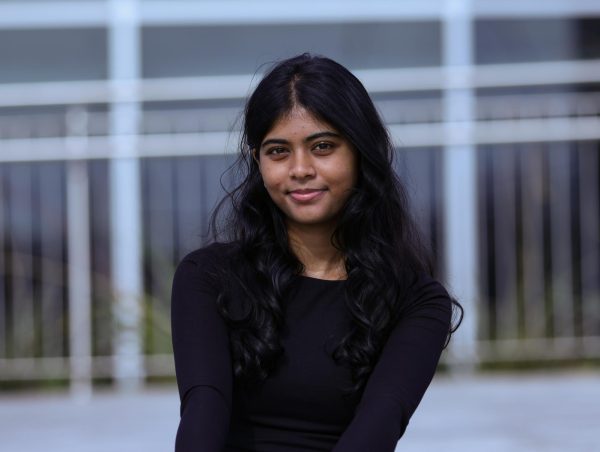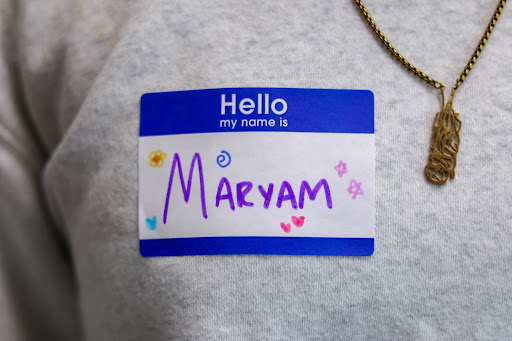
My name is Maryam Amatul Aziz. I have never told anyone that before.
It is pronounced “muh-ree-yum.” With a rolled “r.” Not “mare-ee-yum,” contrary to popular belief.
Growing up, my mother would tell me how sacred it is. I hated it.
Despite Maryam being my birth name, I have had little use for it. I am a woman of many titles: My little siblings call me “aapi” — an affectionate term for “older sister” in my native language, Urdu; my elder sister and I only address each other in “bro’s;” and my parents fondly refer to me as “Mannam.” The only people who call me Maryam are my grandparents, and, outside of my family, my real name is mispronounced by everyone in my life. But I never really cared.
The mispronunciation of my name began as an insecure choice when I was six years old. During roll call on the first day, my teacher paused when it came to my name and asked if she was saying it right.
Having gone through kindergarten constantly correcting people for pronouncing my name with a “mare-ee” and not a “muh-ree,” first grade Maryam was tired and embarrassed. In addition, I was one of two brown, Muslim girls in a predominantly white elementary school. I constantly felt out of place — a feeling that grew more exhausting as time passed — and I yearned to earn my place by being easy, convenient and people-pleasing. I felt as if I was expecting too much by correcting people on my name, so I conceded.
I let my name be mispronounced that day, and ever since, I have been called a name I hold no real attachment to.
However, since then, I have had multiple chances to set the record straight on my name. Every year, teachers asked students to explain their pronunciation, but every year, I chose to keep the incorrect form of my name. This was partly due to people’s attempts at rolling the “r” in my name ending up with them donning a thick, superficial Indian accent that felt almost like a microaggression.
But in truth, as time passed, I let the incorrect version of my name spread as a shield. I was raised in a very religious Muslim household, and while my parents encouraged free-thought and curiosity in their children to question the rules around them, I often felt inferior due to my name sake: Mary, mother of Jesus. My full name roughly translates to “Mary, devout servant of The Almighty.” Safe to say, it has been a lot to live up to.
When upset with me, my mother would often compare me to Mary, saying “don’t you know who you are named for? Have some respect.” Although my Muslim heritage is very important to me, I am nowhere near the “perfect” Muslim, and this comparison only spurred me to use my “Americanized” name as a wall between religious and familial expectations. As a result, my name became forgotten to almost everyone: I kept my middle name a secret, and my true name was barely used at all.
However, as my grandparents age, I realize more and more how much of my culture is attached to them. My only reason to speak my native language and call myself by my proper name is because of them. With the passing of time, I worry that my culture will leave with them, and for that reason, I have started caring more about connecting with my cultural and religious identity, including my name.
It’s baby steps — I’m more open about my culture and I’ve begun to introduce myself with my correct pronunciation to new people. I’m still okay with people pronouncing it wrong, because these people have known me as that for so long. Just as my given name has always been a part of me, the “Americanized” version of my name has become a part of me, and I’m not ashamed of it. I just want the true version of myself to have more exposure.
My name is Maryam Amatul Aziz. I have now told the whole world this fact.
It is pronounced “muh-ree-yum,” with a rolled “r.”
I am Muslim. I am far from a perfect one, but I am one nonetheless. My name is sacred, and I am deserving of it.